Two Companies Renamed Themselves a Week Apart. Their Logic Was Opposite.
In short
Sempreon and Duke's Mayo renamed themselves a week apart with opposite logic. Here's the data to check before you rename your company or brand.
Key points
- What happened
- Sauer Brands became Duke's Mayo Company (26 October 2026).
- The numbers that explain Sempreon's decision
- This is the part that interests us.
- Every option has a cost
- Both decisions make sense, but neither is free.
- What a new name can't do
- Sempreon announced its name during a hard stretch.
Full article
Short answer: On 26 October 2026, Sauer Brands became Duke’s Mayo Company, taking the name of its best-known product. Seven days later, MGP Ingredients became Sempreon, a new name that points to no product at all. These opposite decisions both make sense, because the businesses are built differently. The lesson: a company name should be decided from data on business mix and name equity by audience, not from taste.
What happened
Sauer Brands became Duke’s Mayo Company (26 October 2026). Founded in 1887, the company had just sold its spices and seasonings business to Watkins. What remains is a condiments portfolio: Duke’s Mayonnaise, Mateo’s Gourmet Salsa, and a foodservice business. The corporate name was aligned with its best-known brand.
MGP Ingredients became Sempreon (2 November 2026). Announced on 15 October, the name took effect alongside a new Nasdaq ticker, CASK. The 85-year-old company runs three businesses: Branded Spirits, Distilling Solutions, and Ingredient Solutions. The name blends “semper” (Latin for always) and “aion” (Greek for eternity). CEO Julie Francis said it “brings all three of our businesses under one identity”. The MGP name lives on at its distillery in Lawrenceburg, Indiana.
The numbers that explain Sempreon’s decision
This is the part that interests us. In its third-quarter 2026 report, the company posted sales of US$117.9 million, split as follows:
- Branded Spirits: US$58.2 million, about 49%
- Ingredient Solutions: US$30.8 million, about 26%
- Distilling Solutions: US$29.0 million, about 25%
Percentages are our calculation from the company’s report, for one quarter.
So the word “Ingredients” in the old name literally described only about a quarter of sales, while nearly half came from spirits brands such as Penelope Bourbon. The name had fallen behind the business. When three businesses serve different audiences, a neutral new name can cover all of them.
Duke’s Mayo sits in the opposite position. Its portfolio has just narrowed, and the company says both of its main brands hold leading Net Promoter Scores in their categories, although it didn’t publish the figures. When your strongest asset is clear, using its name is a logical shortcut.
Every option has a cost
Both decisions make sense, but neither is free. Here’s our reading:
- Sempreon starts from zero. A new name carries no equity. Eighty-five years of value has to be moved across gradually, which is why keeping MGP at distillery level is a smart move.
- Duke’s Mayo has a narrow name. Salsa now sits under a company called “Mayo”. If the portfolio moves far beyond condiments, the name could become a limit, just as “Ingredients” did.
In Indonesia, there’s a third pattern. On 6 October 2026, Danamon and MUFG Indonesia introduced a proposed name, Bank MUFG Danamon, for their integrated bank, still subject to approval from shareholders, the relevant ministries, and regulators. When two names both hold value, combining them keeps both, at the risk of a longer name.
What a new name can’t do
Sempreon announced its name during a hard stretch. Third-quarter sales fell 10%. Distilling Solutions fell 29%, and the company itself described an oversupplied market with high industry barrel inventories. We see no cause and effect between the name and these numbers, and the company didn’t promise any.
That’s the point: a new name can clarify what you do, but it doesn’t change market conditions. And with the name only a week old, it’s too early to judge the result.
The data to check before renaming
The public sources we read don’t explain the research behind either decision. But if your company is considering a rename, this is what we’d look at first:
- Business mix. What share of sales does each line bring, and what’s the trend? Does the current name still describe most of the business?
- Name equity by audience. How well known is the name, and what does it stand for, among customers, distributors, employees, and investors? Measure them separately, because the results often differ.
- The name’s role in buying. Do people choose the company name or the product name? Look at search volume, tender data, and interviews with your sales team.
- Room to grow. Does the candidate name still fit the five-year business plan?
- Migration cost. Trademarks, contracts, permits, signage, packaging, domains, and SEO. Decide too which old names you’ll keep.
Which pattern fits your business?
- A neutral new name: fits when the business is diverse and the old name is too narrow. The cost: building equity from scratch.
- The hero brand’s name: fits when the portfolio is focused and one brand is clearly strongest. The risk: the name limits expansion.
- A combined name: fits a merger of two names that both hold value. The risk: it’s long and can feel like a compromise.
- No rename at all: often the right answer, if the real problem is positioning or execution.
How EGGHEAD approaches it
As a data-driven branding agency, we separate “should we rename?” from “what should the name be?”. We start with a Brand Audit to measure name equity across internal and external audiences. From there, the Brand Strategy phase sets the brand architecture, and only then does rebranding move on to the name and visual identity.
Considering a rename? Talk to the EGGHEAD team or explore our brand strategy approach.
FAQ
When should a company change its name?
Usually when the name no longer describes the business, for example after an acquisition, divestiture, or merger. Sempreon and Duke’s Mayo both renamed after their business mix changed. If the problem is positioning or execution, a new name may not solve it.
Why did MGP Ingredients become Sempreon?
To bring its three businesses (Branded Spirits, Distilling Solutions, Ingredient Solutions) under one identity. The name took effect on 2 November 2026 with the Nasdaq ticker CASK. The MGP name stays on its distillery.
Why did Sauer Brands become Duke’s Mayo Company?
To align the corporate name with its best-known brand, after selling its spices and seasonings business and focusing on condiments. The name took effect on 26 October 2026.
What data do you need before renaming a company?
Sales mix by business line, name equity by audience, the name’s role in buying decisions, the long-term business plan, and migration costs including trademarks.
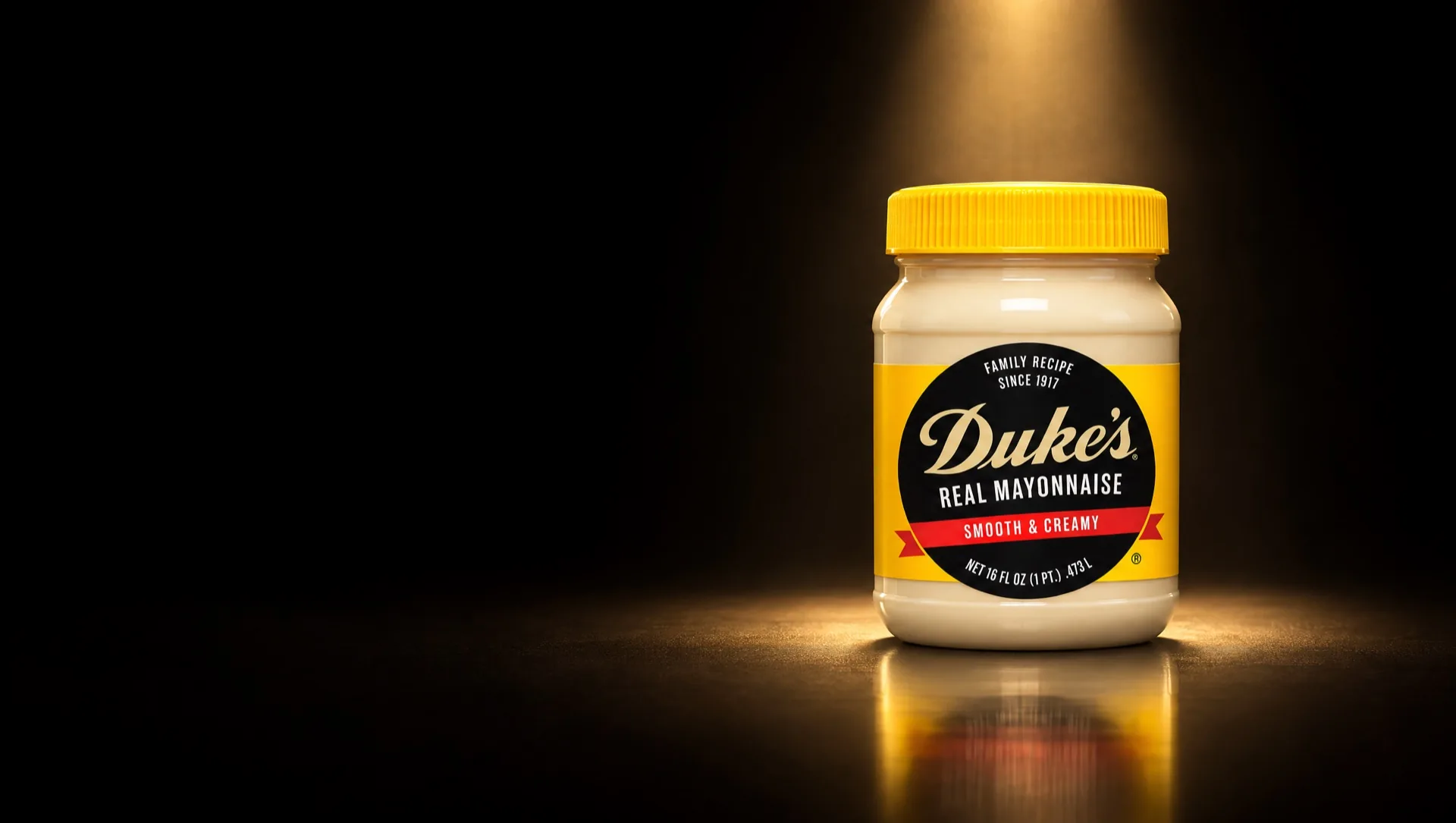
Image: AI-generated illustration based on Duke’s Mayonnaise’s real packaging, not an official Duke’s Mayo Company photo.
Sources
- Sempreon (MGP Ingredients), Form 8-K Exhibit 99.1, third-quarter 2026 results, 28 October 2026: sec.gov
- MGP Ingredients rebrand press release, 15 October 2026 (published by Breaking Bourbon): breakingbourbon.com
- Just Drinks, “MGP Ingredients to change name to Sempreon”, 15 October 2026: just-drinks.com
- Drinks Intel, “MGP Ingredients becomes Sempreon”, 2 November 2026: drinks-intel.com
- The Shelby Report, “Sauer Brands renames itself Duke’s Mayo Company”, 26 October 2026: theshelbyreport.com
- Republika, “Integrasi Berlanjut, Danamon dan MUFG Usulkan Nama Baru”, 7 October 2026: ekonomi.republika.co.id